Saturday, August 10, 2013

Donate Today to My Kickstarter Campaign!


Yesterday, on Friday, August 9, 2013, my friends and I in Restoration Project launched our first-ever Kickstarter campaign. We're trying to raise $10,000 in 30 days to pay for the recording and production costs for a new EP series we're calling Firm Foundation.

Watch our campaign video and view our Kickstarter page here:

http://kck.st/13SvBmM

Our Firm Foundation recordings will feature Sunday School songs with new arrangements and lyrics—bringing greater theological depth and clarity to the originals you may already know. Just read about it, watch the video, and donate on our campaign page! It's better watched than described.

Learn more about Restoration Project's mission and history and listen to our two, previously released albums on our website: http://resproj.com.

You can also share our fundraiser on social:

Share to Twitter
Share to Facebook

Thanks for your support!

Wednesday, August 7, 2013

Sight-Reading for Guitarists

One of the most important skills a guitarist can possess is the ability to read music.

I've said it. I mean it.

Great guitarists don't need to know how to read music, but well-rounded ones do - especially when it comes to comparing musicians of other instruments. Guitarists are the target of a lot of snobbish derision when it comes to their abilities to sight-read. But if we can read music, then we get the best of both worlds: playing from the heart (without music) and playing with precise calculation and technique (reading music).

I owe a big apology to one of my former guitar students, for whom I was supposed to write this special blog post a few days ago. This one is for Joe.

The attached image can be used for sight-reading in any position. Don't memorize it. When you feel like you're starting to get familiar with the order of the notes, flip the sheet upside down. Voila! It's a new page to practice. Here are the most important positions and keys to start with:
  • I - Keys: C, G, D, A, E, F
  • II - Keys: C, G, D, A
  • IV - Keys: D, A, E, B, F
  • VI - Keys: E, B, F
  • X - Keys: G, D, A, E
As you begin, start by reading a single note at a fairly slow pace. Consider each note head to be the same duration.

You're reading whole notes. When you feel comfortable with single notes, move on to reading two notes at a time. Now you're reading twice the information at one time, and you're reading half notes. I think you get the point. Increase the number of notes you read at a time. Some key benchmarks are as follows:
  • 3-note groupings - reading in 3/4
  • 6-note groupings - reading in 6/8
  • 8-note groupings - reading in 4/4
  • 12-note groupings - reading 4 measures of 3/4 at one time
  • 16-note groupings - reading 4 measures of 4/4 at one time
If you're hungry for more, and you're serious, you can write out your own pages, following mine as an example. In my page, I've limited my notes to C3 up to A4. However, the reading range for guitars goes down to E2 and all the way up to E6, approximately, so if you make your own practice sheets, be sure to utilize all of the pitches in your given fret position. (You won't be able to flip the sheet over when the notes become too familiar to "make" a new sheet, but it will give you the full range for guitarists.)

I have based my sheet on David Hickman's book, Music Speed Reading, which is out of print as of this post. Original copies of Hickman's book are currently fetching $150+ on Amazon.com.

Have any questions or comments? Please use the form below. And good luck!


Disclaimer: All resources on this blog are intended for personal use only. If you are a music instructor - public or private - and would like to use some of the resource materials I have created, please contact me to get permission before using them with your own students.

Sunday, April 28, 2013

Brad Paisley, Reverend Guitars, and Doug Seven


I've had an itch for about three months now to purchase a guitar capable of pulling some serious Southern twang (in the style of Brad Paisley). At this point, I feel like I really have two options:

A Reverend Buckshot or a Fender American Tele Deluxe. The next time I'm down out Chicago Music Exchange, there's a good chance that I'll be dropping either $750 or $1,700, depending on which of these two guitars I like the feel of more. Yeah, that's a pretty big price spread. But, more than anything, I want to get the right guitar. Sometimes it's not about price.

To prepare for my new purchase, I've been wanting to learn a few extra Paisley-esque licks. A quick search on Google this afternoon turned up a number of videos, and I decided to watch the one that looked the best from its screenshot. As it turns out, I stumbled upon a Southern dude named Doug Seven, who seems to have quite a reputation. Here's the video:

http://youtu.be/HavXOVP-3BQ

(The video is 15 minutes long, but the first 6 or so minutes will get you the bulk of the good stuff.)

If you're interested in this chicken pickin' style, Doug recommends picking up one of his books/DVD's - probably a worthy investment, based on what I've seen. So go check it out!

Also, I'm curious to see which Tele paint job you like best. Check out the current models and let me know which one you think I should get:

http://www.fender.com/series/american-deluxe/american-deluxe-telecaster/

Sunday, April 14, 2013

Lesson 2: How to Tune a Guitar (Relative Tuning)

Time and again I find guitar students who have no idea how to tune their instruments without plugging in to a guitar tuner. Private guitar teachers: this is your fault!

Usually at some point in the first month of lessons, I will teach all of my students what is called "relative tuning". That is to say, tuning so that the guitar will sound good by itself, without any other instruments playing with it. If you want to play with other musicians, you'll need to tune to "concert pitch", which is a standard tuning which all instruments follow in order to play together, in harmony.

If a guitarist is alone in the woods, can he still play his instrument "in tune" and sound great?

The essence of relative tuning is that each string on the guitar is tuned to properly relate, intervallically, to each other. In music theory terms, the interval between each neighboring string, with the exception of G to B, is a Perfect 4th. String G to B is a Major 3rd.

It's a lot easier to just show you what I mean (as opposed to trying to explain it in words, on a blog). So I'm just going to post my worksheet and let you figure the rest out on your own! If you have any questions or comments, please feel free to leave those below.

Don't forget, here's the link to my... post series on guitar lessons curriculum.


Disclaimer: All resources on this blog are intended for personal use only. If you are a music instructor - public or private - and would like to use some of the resource materials I have created, please contact me to get permission before using them with your own students.

Tuesday, February 19, 2013

Top 10 Practice Tips: Stick to the Plan (8 of 10)

"If you fail to plan, then you plan to fail" as they say. By "they" I mean about a zillion people. But some attribute this exact quote to Harvey MacKay.


Some of my guitar students have expressed to me the frustration of not improving after hours of work on a song, technique or exercise. In some, very few cases, these frustrations are due to what physical trainers call "the hump". Getting over it takes discipline and resolve. What one is doing is maxing out his or her physical capacity to perform.

But I don't think the "getting over the hump" theory is what prevents most people - and most guitarists - from improving.

I think the real challenge - the real hurdle - is a lack of planning - or not knowing how to plan - in order to succeed. Developing a plan isn't always easy - especially for young players - but with a little practice, everyone can improve his skills on guitar.

There are two things I want to touch on here as we really get in to what a "guitar playing improvement plan" can look like:
1. Continue to practice everything you've learned.
This is hard to do, but for anyone who has played for more than about a year, you really need about an hour of playing five days a week in order to continue improving. Half of that time ought to be practicing what you already know. The remaining 30 minutes ought to be skills you're developing. Yes, I'm talking 60 minutes a day. That's five hours of guitar a week. (Cut back on Call of Duty, please.)

Here's one suggestion for your 30-minute daily reviews:

Day 1: Pentatonic scales and exercises
Day 2: Bar chords and inversions
Day 3: Major and natural minor scales and exercises
Day 4: Arpeggios (major, minor, augmented, half- and fully-diminished 7th chords)
Day 5: Harmonic and melodic minor scales and exercises
2. In order to pass "the hump", athletes and musicians have to increase their capacity by focusing on their weakest links.
For me, this applies really well to rock climbing. It's simple: if I focus only on the types of climbs that I'm good at and like to do, I'll never be a great all-around climber. If I'm a great slab climber and I choose not to work on finger strength on over-hanging routes, I'll never be able to climb over-hanging routes.

On guitar, maybe you hate scales because you suck at alternate picking. Well, you'll never be able to play those quick lead/solo lines well. Want to learn that Jimmy Page solo in "Black Dog"? Not gonna happen without some serious practice on your weaknesses. You know where this is headed...

So how do you know where you're playing is weakest?

Time to eat humble pie, folks. You need to play with people who are better than you. They don't have to be guitarists - just better musicians.

Let this be duly recorded:

If you are in a band and you don't think to yourself at every rehearsal "What a privilege! I get to play with musicians who are better than me every week", then you need to quit and find a new band.

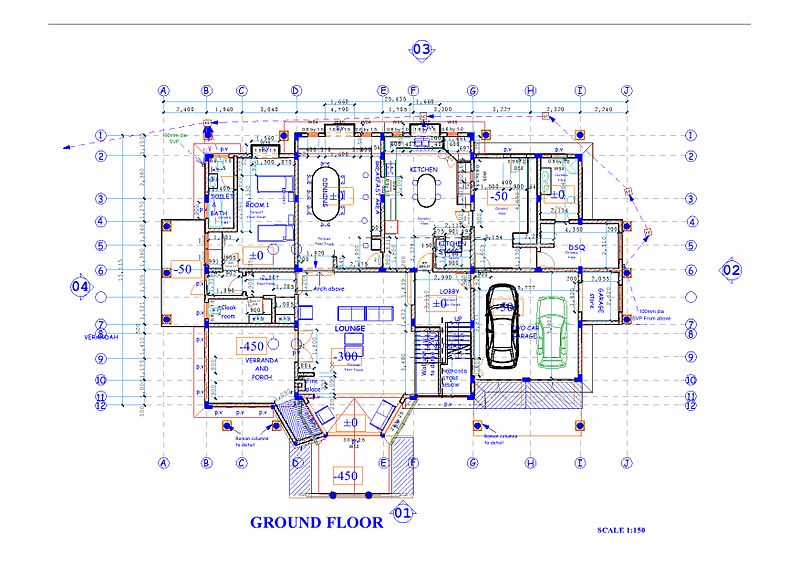
Photo credit: http://commons.wikimedia.org/wiki/File:Housee_BLueprint.jpg

Friday, December 7, 2012

Lesson 1b: Picking Technique and Open-String Exercises

One of the toughest things about starting to learn guitar is gaining control and accuracy of your right hand - both single-note picking and strumming chords (if you're learning on a right-handed guitar, that is). In my first lesson, if we have time after covering the parts of the guitar (lesson 1a), we dive right in to playing the guitar.

Not particularly musical or fun, but fundamental. Open-String exercises are helpful to new students in a few ways:

1. The student gets comfortable holding the guitar and practicing good posture.
2. The student begins to develop right-hand precision - getting a feel for the spacing between each string - which will help with playing scales and strumming.
3. The student is practicing ear-training from day one (that means the student is beginning the process of being able to know what each note of the guitar sounds like and what the relationship is from one string to the next.)
4. The student begins to practice playing even, or steady, rhythms - necessary to play any form of music on any instrument.

But before getting into actually playing these exercises, we have to talk about two things:

1. How to hold a guitar pick. Flip your right-hand index finger straight out and completely flat, palm-side up. With your other hand, place the pointy corner of the guitar pick on your index finger, make sure that about 1/4 inch of the pick sticks out over the end of your index finger (like an extension of your nail), then quickly "snap" your right-hand thumb on to the pick comfortably. That's it!

2. Rule*: Use Alternate Picking. Alternate picking means using an alternating "down then up then down etc." motion when playing each note or chord. If your first note is played by picking down (approaching the string from above and striking it down toward the ground), then the next picking stroke should be up (the opposite of the last). Always "down, up, down, up" when we're working with steady rhythms (IE: the rhythmic value of each note is the same).

*Every week or so I add a new key rule or principle for students to memorize. Most of the time, it's the absolute, bear essential piece of information a student has to walk away from a lesson with.

Here is the worksheet I often use with my students. Remember, it's all open strings, so pretty much all students can get started with this right from the first lesson. No chords to learn or worry about. Easy peasy.


Disclaimer: All resources on this blog are intended for personal use only. If you are a music instructor - public or private - and would like to use some of the resource materials I have created, please contact me to get permission before using them with your own students.

Wednesday, September 5, 2012

Buying Acoustic Guitars over $1,500


This post is a continuation of a series I've been doing on how to buy a guitar. You can read the other posts here:


Acoustic Guitars over $1,500

Now we're getting into the really good stuff. Once you hit this level, you're looking for hand-crafted instruments only, built right here in the US of A or Canada. I don't personally know of any premium quality guitar makers outside of the States or Canada. In this price-range, it's all up to personal preference regarding body style, tone quality, types of wood used, etc.

Personally, I prefer Gibsons uber alles (over all others). Next come Martins, then it's a toss-up between Seagulls and Taylors. I prefer the sound of Seagulls, but the Taylors appear to retain their value better. Remember, though, there are a lot more Taylors on the market right now, so conceivably that could mean they'll be worth less over time - which is not what you want when you're paying this kind of cash.

Guitars in this price-range - and especially over about the $2,500 threshold - are instruments that ought to appreciate in value over time. You aren't just buying a guitar - you're buying an investment. (And that means get it insured! Standard renters or homeowners policies often don't cover these items and require an additional rider.)

This price-range also means that you can seriously consider buying "used" - or as collectors say "vintage". The key here is to do your homework. Find out the make, model, and year of the guitar you're looking to purchase and then find out if the manufacturer fudged on quality or materials during those years, etc.

Go with your gut. If the instrument feels and sounds great, buy it. In some cases, you should do "blind" playing tests to see which ones you like best.

For vintage instruments, I steer clear of Craigslist, Ebay, and other online shops. I also steer clear of big-box retailers like Guitar Center and Sam Ash - especially in Chicago. (I actually don't buy anything from Sam Ash - ever.)

I go with guitar shops that specialize in vintage gear. And unfortunately, there aren't many like that in the Chicago area. Your best bet for vintage is to take a trip South. Make a weekend out of it. Go to Nashville. Even Guitar Center in Nashville has a killer vintage section (this is the only time I'd still consider a big shop for my purchase).

I don't have any specific shops in Nashville to recommend to you at the moment, but if you're serious about making the trip, I have a handful of musician friends who live down there and I'd be happy to get a few recommendations from them.

In addition to snagging a killer vintage instrument, there are other, great reasons for making the trip just to buy a guitar: the experience will be unforgettable, the prices are cheaper than Chicago (because of the high number of vintage pieces available), the variety is greater (you get to try out a ton of guitars before you decide what to buy), you'll meet and network with real musicians in Nashville.

Questions? Comments? Need to contact me? Visit my Guitar Lessons site and email away!